Saturday, 21 May 2011

James Harvey d'Egville Shows His Playful Side

Charles Mathews (1776-1835)
by C. Turner (1825)

One morning at rehearsal, "His Innocence" (casually, of course) remarked, as Mr. Mathews left the room (who was, at this period of his life, the thinnest of human beings, and far from possessing even tolerable health), that "it was hardly to be credited, while looking at his slight form, what extraordinary muscular strength he possessed."
"What-what-what, Mathews!" cried Dowton— (for whom the snare was laid) startled by so transparent a fallacy, "why-why, he 's a poor weak creature !—what can you mean by strength ?—why, I 'd undertake to knock him down with my little finger." (Mr. Dowton piqued himself upon his really muscular frame.)
"Don't you be too sure of that" said Russell, coldly; "have you ever tried?"
"No," said Dowton ; " but I can venture to say that he has not the least muscular power—a poor, consumptive young man; poor fellow, without an atom of sinew or muscle in his whole composition."
"Well!" mildly, yet reprovingly, drawled Russell, "but you shouldn't speak, Dowton, without proof—now I have seen Mathews perform the most marvellous feats of strength, and therefore I know what he can do. Why, D'Egville (of course, D'Egville was promptly confederate in this trick), muscular and Herculean as is his frame, he would find Mathews more than his match, if they came to the test."
"Oh, nonsense and stuff!" said Dowton, impatient at the manifest folly of Russell's assertion; "don't make a fool of yourself;" and D'Egville, affecting also to laugh at the idea of his being overcome by Mathews in a trial of strength, Russell coolly expressed his convictions that "Mathews, in wrestling, would conquer D'Egville," and declared he would back his opinion with a five pound note; and just as he took it from his pocket, Mr. Mathews, (quite unconscious, of course, of what had been going on), returned. The sight of his spare figure seemed to stimulate Dowton's courage and opposition, and he hastily dived into his pocket, saying—" Well, for once, I-I-I-I will lay a wager, and get that-that-that eternal five pound note from you, for you deserve to be punished for your obstinacy; so, here, Barrymore, do you, do you hold the stakes." Hereupon, Russell calmly and confidently placed his note in Mr. Barrymore's hand, and Dowton began to count from his purse a similar sum; but as he was about to place the coin with the umpire, his metal was shaken at the tranquil and assured air of Russell, and he drew back his cash, declaring that he would not indulge Russell in the love of betting on every occasion—and recanted; at the same time repeating his conviction that "he should be robbing the foolish fellow of his money if he betted upon such an absurdity."
Mr. Mathews having however cheerfully consented to this proof of his superior strength, wrestled withD'Egville, who acted his part so well, that he frequently fell under his antagonist's extraordinary bodily power, and in fact, was so worsted in the struggle that he admitted with much apparent mortification, that he had no chance with him. At the same time, Dowton, pale with amazement, declared he would not have credited the fact had he not witnessed it, and ever after, while he could not withhold his wonder that a man of such apparently weak frame, could be capable of such vigorous energy, Mathews was ranked amongst the Athletes by his brother comedian.

Anecdotes of Actors: with other desultory recollections, Anne Mathews, 1844


Friday, 20 May 2011

James Harvey d'Egville: Before Super Injunctions

— Our libel law, under the auspices of the best of judges, and administered by most sapient juries, is making noble strides. M. D'Egville, the gentleman who deserves the thanks of all the saints on earth, for having cured the young men of the present day of the sinful taste for ballets, brought an action against The Age newspaper for this paragraph:—
"The ballet at the opera on Tuesday last was impudently asserted in the bills as the composition of M. D'Egville, Siege de Cythere, when it was originally composed and produced by M. Dubervalle.The only credit due to D'Egville is the extraordinary memory to have so closely followed the original in every scene, group, and action, unless he made memoranda at the time, which I presume was the case. The writer of this was in Dubervalle's ballet when first produced at the old Pantheon, and thinks D'Egville can only copy, not compose. For example, his previous ballet of Rose Blanche was originally performed at Odenot's two-penny theatre on the Boulevards, expressly for the revolutionary gentry of 1792, about the time of the martyrdom of the Princess Lambelle and others, when D'Egville was very conspicuous in Paris, and accused of being the bosom friend of the murderer that carried that unfortunate princess's head on a pole."
The first allegation is, that the ballet was not Mr. D'Egville's work, and it is therefore one for which he ought to be especially grateful. It would be well for him indeed, if his enemies would deprive him thus of the discredit of the different dull performances with which he has vexed our eyes. The second charge, if charge it can be called, which carries no imputation with it, is that monsieur was conspicuous in Paris, at the time of the Revolution. Being conspicuous is hardly in itself a crime, we presume. But lastly, he was accused of being the bosom friend of the murderer of the Princess Lambelle.
" The learned counsel (Mr. Phillips) said, that this was the libel for which the plaintiff sought compensation at the hands of the jury, and he believed that a more atrocious and unprovoked attack never was made on a respectable man. It was as false, too, as it was calumnious. The plaintiff, so far from being active in promoting the Revolution, was conspicuous in the ranks of loyalty, and had hazarded his life in the service of the unfortunate monarch who then filled the throne of France. He put it to the honour of the jury, as to what must be the feelings of the plaintiff when he saw himself represented as the bosom friend of the greatest monster and most blood-thirsty wretch that figured at that sanguinary period."
We are extremely glad to learn, that a more atrocious and unprovoked attack (than the above quoted) never was made on a respectable man. We rejoice to discover that respectable men, from the beginning of things down to the present time, from Adam to D'Egville, have had nothing worse to complain of. "But what," asks the counsellor, (Phillips,) "must be the feelings of the plaintiff, when he saw himself represented as the bosom-friend of the monster," &c. The inquiry is beside the question, simply because Monsieur D'Egville never saw himself represented as any such thing: the terms of the libel are, that he was accused of being the bosom friend, &c; and there is a wide difference between the representation of an accusation, and the representation of the fact, though it may escape the clear logical perception of an Irish orator.
" The Chief Justice [of the Common Pleas, be sure] summed up the case. To charge the plaintiff with being the intimate friend of a man concerned in one of the most sanguinary murders that was recorded in the history of modern times, was a gross libel, the defendant having admitted the falsehood of the statement by not pleading the truth of that statement. The jury would say what was a failcompensation to the plaintiff for the injury."
Again we observe that the libel did not charge; it merely alleged that the party was accused of an intimacy with a detested character. No defence was made; and the jury, under the circumstances, with the wisdom and moderation which now distinguish juries in libel cases, brought in a verdict of 150l. damages for the dancing master, who has not in the whole course of his professional life taken a more profitable step than this prosecution. In these remarks we are far from intending to justify the paragraph in The Age; it was of the customary complexion of that paper, which we have ourselves more than once described with the natural expressions of disgust; but we do contend that 150l. or a hundred and fifty shillings damages for it, is a sum utterly disproportioned to the injury. There was no defence, however, and the jury perhaps acted on that common principle which caused the chimney sweeper to be " thrown over" from the one shilling gallery, his abrupt ejection accompanied with the sound reason, "he ha'nt got no friends." Being in no degree better than the rest of the world, we should possibly not trouble ourselves much about this manner of disposing of chimney sweepers, were it not that we sit in the pit below, and we have our fears lest the fall of the chimney sweeper should touch our own heads. Therefore, though by no means partial to the chimney sweeper, we protest against throwing him over, even though he "ha'nt got no friends." He is a dirty sooty fellow by trade, but in punishing him beyond his offence, you may, most worthy jurors of the one-shilling gallery, lead to the injury of others who have not offended at all. You are encouraging, nay, actually rewarding a morbid sensitiveness which may be extended to the annoyance of you all. You begin with throwing over the chimney sweeper: well and good, we are all afraid of being befouled, and will not quarrel about him. But there is the baker, who is not an agreeable neighbour to the gentleman in black, and he will go over next; and there is the tallow chandler, who is not redolent of frankincense, who will follow; and the greasy butcher, and one man has a bad breath, and another's pores are too open, and another occupies more than a fair allowance of room, and another has a cough which interferes with your hearing; in short every one has some little annoying quality, and getting on from the greater nuisances to those next in degree, you will at last find that you yourself are in danger of suffering under the law you have put upon others. You say that you are safe, John, because you don't write; but you speak, man—great folly to be sure, but still speech, such indeed as it is ; and if calling a bailiff a bum is declared a wicked and malignant libel, according to the best doctrine, I should like much to know what may not be considered as calumny. There are actions for words as well as for letters.
But what will be the issue of the present blind rage against the press? Verdicts will encourage actions out of number, on slighter aud slighter provocations, till Mr. Bull grows weary of convicting libellers, and then a reaction will take place. A cold will succeed a hot fit, and after having found every thing libellous, our juries will find nothing libellous. The press will then, after a term of persecution, enjoy a term of tyranny. It will say and do what it likes with complete impunity. There are with John Bull fashions, in justice, as in all other things. It is the fashion just now to find verdicts of guilty in cases of alleged libel; it will be the fashion soon to give verdicts with a not before them. Reason has no voice in either decision. It is the mode—the mode, the mode's the thing!
In the report of M. D'Egville's action, it is said that a witness proved that Monsieur had produced, among other successful ballets, the Siege de Cythère. We certainly had not the slightest idea that the success of all or any of M. D'Egville's ballets could be proved in evidence. A pit more than half empty before the ballet is half over, was doubtless one of the facts instanced.
The London Magazine July 1827
Diary for the month of June (9th)

Thursday, 19 May 2011

Serendipity In The Pages Of The London Gazette

The London Gazette is useful online resource for discovering all sorts of family information that is published in the public domain. I've found it invaluable when attempting to analyse the circumstances in which our ancestors lived.

Sometimes one discovers the unexpected. For example here is my grandmother, Gladys Elizabeth Degville, newly appointed as a telephonist in Birmingham (published 5 March 1929).


After the death of her parents my grandmother was brought up in a convent and had little contact with her extended family. Here The London Gazette is advertising her late father's estate so that it could be claimed by his kin. This process seems to have gone on for some time after the end of the First World War as this particular advert appeared on 4 May 1926.


When my grandmother fled the convent to live in the YWCA and avoided being resettled in Canada she would have thought £1.16 (and that is shillings not pence) a small fortune.

Gladys Elizabeth Kimberley nee Degville (1911-1991)
with my father John Kimberley

Wednesday, 18 May 2011

The Guillon LeThière Family

I'm now quite satisfied that the 'Baron Saint Leger' and Auguste Guillon LeThière (1796-1865), the husband of Adèle Sophie Bizet d’Egville, are the same person. His father was Guillaume Guillon LeThière (1760-1832) but I'm unsure of the identity of his mother. It wasn't the mother of Guillaume's youngest son Lucien, Marie-Joseph Honorée Vanzenne (1763-1832), as they didn't marry until 1799.

Guillaume Guillon supported the revolution and was a friend of Jaques-Louis David, who provides a tenuous connection to James Harvey d'Egville. Guillaume was renowned for his quick temper. When he believed some soldiers had insulted his moustache he drew his sword and several soldiers were killed in the brawl. Lucien Bonaparte intervened and as a result Guillaume was appointed director of the French Academy in Rome.

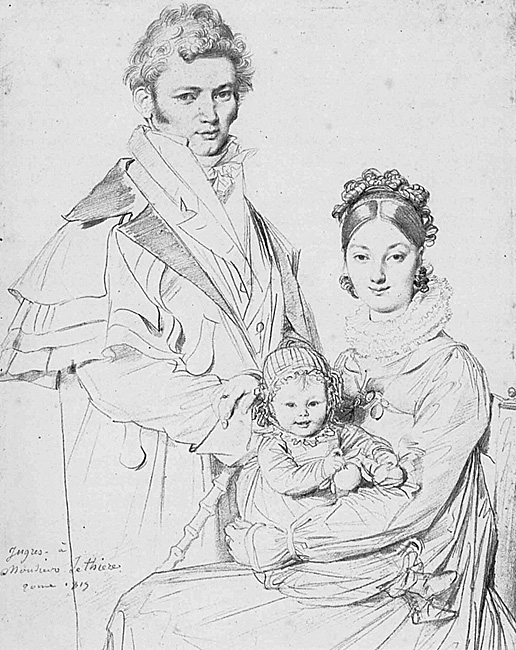
While in Rome members of the Guillon family were vividly portrayed in pencil by Jean Auguste Ingres. His draughtsmanship is crisp but Ingres' paintings almost breathe so it is great pity that none of this family became his subjects on canvas.

Guillaume Guillon LeThière


Madame Guillon LeThière


The Alexandre Guillon LeThière Family

Auguste Guillon LeThière

Tuesday, 17 May 2011

More Bizet Bankruptcy

Until the Debtors Act of 1869 insolvent debtors were regarded as criminals and could be imprisoned. For those without friends and relations or lenient creditors this could be a life sentence.

Insolvency was seen as the moral failure of a person to live within their means and the processes seem to have evolved to shame the debtor. Details of bankruptcy proceeding were published in the London Gazette for all to see.

Members of the extended d'Egville family were unable to avoid debt and insolvency in the nineteenth century. My working hypothesis is that where the families were clustered together in London, Brighton and Worcester there were just too many d'Egvilles and Michaus trying to make their livings as teachers. Of course being a good dancing teacher is not necessarily correlated with possessing good business sense.

The bankrupt George Harvey d'Egville relocated from Worcester to Edinburgh where he seems to have avoided the courts. His uncle, George Harvey d'Egville, spent the second half of his life in Atherstone where he never had to endure the ignominy of Bankruptcy.

This is not to say that these two gentlemen were not in debt. Despite the shame associated with bankruptcy credit was a driving economic force among the middle classes. A household would have relied on informal credit arrangements with local traders for its day to day operation. Then, as now, it was a fine line between successfully those managing credit arrangements and falling into insolvency.

London Gazette 20 February 1863


London Gazette 9 May 1873

Monday, 16 May 2011

The Baron Writes His Last Words From Italy

The Sardegna Digital Library has a collection of letters in the matter of the Baron Guillon Saint Leger. This extends to over 500 pages of manuscript in both French and Italian.

Their Baron shares his name with Roma Guillon LeThière's father and also has a daughter who is named in one letter as Madame Lescot. Guillaume Guillon LeThière's son Auguste had a naturel daughter named Ea (1821-1902) who married Charles René Lescot in 1840.

Helen C. Black in Pen, Pencil Baton and Mask: Biographical Sketches by Helen C. Black (1896) describes Roma's father as a civil engineer. The Sardegna collection has much correspondence referring to a mining venture. So there seems to be some correlation between this Baron and the man who married Adèle Sophie Bizet d’Egville.

The legend that Adèle's husband was the son Guillaume Guillon LeThière is increasingly credible. While the letters have at least one reference to Madame Lescot's health there is no obvious concern expressed for his wife and daughter. But I still have some hundreds of pages of manuscript to read.

What is certain is the Baron suffered an attack of paralysis and his associates had to contribute towards the cost of his care. In the twenty five years that have elapsed since his imprisonment as a debtor nothing much has changed.

The Baron's final signature included in a letter dated 11 March 1864

Sunday, 15 May 2011

Roma's Skeletons Commence Their Fandango

When Roma Guillon Lethière told Helen C. Black (Pen, Pencil Baton and Mask: Biographical Sketches by Helen C. Black, 1896) that she never let her skeletons dance in public she couldn't have predicted that a little over a century later her secrets would begin to be revealed through a global computer network.

In October 1837, only two years after his marriage to Adèle Sophie Bizet d’Egville and around the time of Roma's birth, August Guillon St. Leger was languishing in gaol. The London Gazette (27 October 1837) published notice of his petition to the Court for Relief of Insolvent Debtors which was due to take place on Monday 20 November.


Even then Auguste's names seem to have caused some confusion. Guillaume Guillon Lethière also seems to have been known as Guillon St. Leger. In an article reproduced in several different works (Revue du Monde Catholique: Volume 12 (1865), Bulletin Historique et Monumental de l'Anjou: Volume Volume 8 (1866) Guillaume is described as the son of the Comte Guillon de Saint-Léger.

An index card in the Paris archives records the birth of an Auguste Louis Leger Guillon called Lethière on 11 June 1796. Due to Guillaume's chaotic private life this may or may not be Roma's father.