Showing posts with label Adèle Sophie Bizet d’Egville. Show all posts

Friday, 22 February 2013

What Became Of Fanny?

According to A Biographical Dictionary of Actors, Actresses, Musicians, Dancers, Managers & and Other Stage Personnel in London: 1660-1800 1(referred to as ABD), Fanny d'Egville flourished 1779-1800 and the authors suppose that she was the third child of Peter and Sophia d'Egville.

Fanny d'Egville's marriage lines from Saint Anne's Church, Soho, reveal that she wed Stephens Ferté Mikel on 7 February 1799. The date fell on a thursday that year and  it was likely to have been cold. The United Kingdom, like much of Western Europe, was grasped by a severe winter. In Scotland there were heavy snowfalls and frosts - transport was disrupted.


The only people that we can know celebrated the wedding with the couple were Fanny's father, Peter, and her brother James. At first I thought that most of the entry, including the signatures of the bride and groom, were all in the same hand as they are so similar. But there are slight differences - and Fanny's hand seems unsteady where she scratched 'F.' Below them are the autographs of Peter and James.

Neith Peter nor James have included the family name Hervé (Anglicised as Harvey). This is in contrast to the wedding lines of Fanny's niece, Adèle Sophie Bizet d’Egville, in 1835 where one of the witnesses signed with only the name Hervé.


The last performance by Fanny that  ABD can cite was at Covent Garden on 2 May 1800. It is quite possible she continued in the theatre, there is now deeper access to playbills than was possible when ABD was compiled (the final pair of volumes appeared in 1993) and her timeline can probably be established with greater confidence.

Fanny may appear in both the 1841 and 1851 censuses. In 1841 a 50 years old Francis Mikel, teacher of dancing, lives at Haverstock Cottage, Saint Pancras. Dwelling with her are: Ellen Lennox, 9 years of age; Isabella Lennox, 6 years of age; Mary Ann Hogg, 50 years of age; and Mary Ann Allbury, 20 years of age. The latter two women are described as F S, female servants. I suppose of one hires woman who share the same name one needn't worry who arrives when one calls out.

In 1851, the still 50 years old Fanny Mikel is a teacher of dancing and head of the household at 32, Lee Road, in Lee, Lewisham. Ellen and Isabel are now 19 and 16 years old, joined by the 14 years old Fanny Lennox. The domestic needs are satisfied by the 55 years old Jane Cole. Almost as an after thought, the 7 years old Henry Davis is listed as Fanny Mikel's nephew.

Ellen, Isabel and Fanny Lennox appear to be Fanny's granddaughters. Their place of birth is listed as Hampstead. The never quite reliable FamilySearch.org has a baptism record for Ellen Georgina Lennox. She was baptised down by the River Fleet at the Old Church, Saint Pancras on 5 June 1832. Her parents are recorded as Frederick Lennox and Frances Josephine Horne.

From these slight facts alone it cannot be concluded that Fanny Mikel is Fanny d'Egville but the coincidence is compelling. While a woman aged 50 in 1841 would have been too young to marry in 1799 there is no particular reason to believe Fanny was telling the truth to the census enumerator.

A swift search of FamilySearch.org provides corroborating evidence from the Old Church at Saint Pancras. On 26 July 1802 Frances Josephina Mikel was baptised, although her birthdate is recorded as 16 May 1800. Her father is listed as Mark Stephens Mikel and her mother is Frances Ferte. What kind of dance could Fanny have performed on 2 May 1800?

1. P.H. Highfill et al. (1982) A Biographical Dictionary of Actors, Southern Illinois University Press ISBN 0-8093-0919-X

Wednesday, 18 May 2011

The Guillon LeThière Family

I'm now quite satisfied that the 'Baron Saint Leger' and Auguste Guillon LeThière (1796-1865), the husband of Adèle Sophie Bizet d’Egville, are the same person. His father was Guillaume Guillon LeThière (1760-1832) but I'm unsure of the identity of his mother. It wasn't the mother of Guillaume's youngest son Lucien, Marie-Joseph Honorée Vanzenne (1763-1832), as they didn't marry until 1799.

Guillaume Guillon supported the revolution and was a friend of Jaques-Louis David, who provides a tenuous connection to James Harvey d'Egville. Guillaume was renowned for his quick temper. When he believed some soldiers had insulted his moustache he drew his sword and several soldiers were killed in the brawl. Lucien Bonaparte intervened and as a result Guillaume was appointed director of the French Academy in Rome.

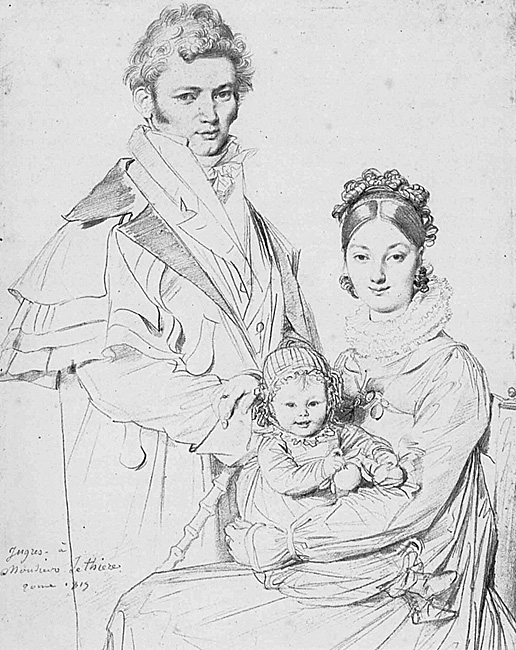
While in Rome members of the Guillon family were vividly portrayed in pencil by Jean Auguste Ingres. His draughtsmanship is crisp but Ingres' paintings almost breathe so it is great pity that none of this family became his subjects on canvas.

Guillaume Guillon LeThière


Madame Guillon LeThière


The Alexandre Guillon LeThière Family

Auguste Guillon LeThière

Monday, 16 May 2011

The Baron Writes His Last Words From Italy

The Sardegna Digital Library has a collection of letters in the matter of the Baron Guillon Saint Leger. This extends to over 500 pages of manuscript in both French and Italian.

Their Baron shares his name with Roma Guillon LeThière's father and also has a daughter who is named in one letter as Madame Lescot. Guillaume Guillon LeThière's son Auguste had a naturel daughter named Ea (1821-1902) who married Charles René Lescot in 1840.

Helen C. Black in Pen, Pencil Baton and Mask: Biographical Sketches by Helen C. Black (1896) describes Roma's father as a civil engineer. The Sardegna collection has much correspondence referring to a mining venture. So there seems to be some correlation between this Baron and the man who married Adèle Sophie Bizet d’Egville.

The legend that Adèle's husband was the son Guillaume Guillon LeThière is increasingly credible. While the letters have at least one reference to Madame Lescot's health there is no obvious concern expressed for his wife and daughter. But I still have some hundreds of pages of manuscript to read.

What is certain is the Baron suffered an attack of paralysis and his associates had to contribute towards the cost of his care. In the twenty five years that have elapsed since his imprisonment as a debtor nothing much has changed.

The Baron's final signature included in a letter dated 11 March 1864

Saturday, 14 May 2011

The Legend of Roma Guillon Lethière

Roma Guillon Lethière

I was once an enthusiastic reader of John le Carré’s novels. A crucial element of the plot of Smiley’s People (1979) is the creation of a ‘legend’ or cover story for a girl by the Soviet spymaster Karla which ultimately enables the eponymous antihero to force his opponent to defect.

In the past months I have become increasingly frustrated and obsessed by the legends created by our ancestors. What once was known of the truth has moved from whispers into oblivion as the generations have passed.

These legends seem to have had two functions. On one hand they created personae for the theatre which were perhaps very different from reality. These emphasise or enhance the truth and build memorable publicity for the performer.

This is no different from what happens today and to a certain extent we all do it. The social processes of constructing family histories select a handful of ancestors which will be remembered while thousands are entirely forgotten or are no more than a name printed on a genealogical diagram.

On the other hand, it was important that the legends of the d’Egvilles and the Michaus should not be a hindrance to them as they moved and marketed themselves among the upper echelons of British society.

Roma Guillon LeThière (c1837-1903) was a prominent actress in her day and her artistic antecedents are carefully cited. In Pen, Pencil Baton and Mask: Biographical Sketches by Helen C. Black (1896),
Roma Guillon Le Thiere is the daughter of the late Guyon Le Thiere, formerly in the Imperial Guard at Waterloo, afterwards a civil engineer. Her grandfather, Captain Augustus Bizet who was shot in the retreat from Moscow was Member of the Paris Institute and Director of the French Academy at Rome, in which glorious city she was born. His widow one of the Harve D'Egvilles re-married, and was the celebrated Madame Michau of Brighton, ballet ' master,' teacher of dancing, and mistress of the ceremonies to Kings George IV. and William. Roma Le Thiere was brought up by her mother from whom she inherits her artistic talents in strict Evangelican doctrines. On the death of her father, pecuniary circumstances made it necessary that the young girl should do something to provide for herself and her beloved mother. Her first step was to write to a valued friend, Mr. George Augustus Sala, and ask his advice. He replied, 'Go on the stage,' to which she answered, ' Have you lost your wits ? I know nothing about it.' The journalist knew better. ' Go on the stage,' he reiterated ; ' if I know you aright, you will make your way

Perhaps because of her ‘Evangelican’ principles Roma lives a full life; her spare time is spent knitting woollens for the poor and persuading them to swear off the booze,
Although a strict Churchwoman, she makes no distinctions, and the warm, tender heart is open to all alike ; but her aid is given in a methodical and practical manner. She wins the confidence and affection of these humble friends, and speaks with joy of their many proofs of appreciation, such as in the case of habitual drunkards, when several took the pledge on her birthday ' because it was the only present we could give you, miss.' 'And they kept it, too,' says Miss Le Thiere impressively, while the good, earnest face beams with interest. ' My visits to my district have often comforted me in my own troubles, but I never let my skeletons dance in public. I keep them to perform their little fandangos in strict privacy at home,' she adds,laughing.

The bones of this biography are to be found in George Augustus Sala’s 1895 autobiography, The Life and Adventures of George Augustus Sala written by himself,
Her [Madame Michau’s] eldest daughter, Sophie Bizet, married a son of the celebrated historical painter, Baron Le Thiere, who, under the First Empire was Director of the French Academy at Rome; and she had a daughter, who still lives to be admired and respected by the members of that dramatic profession which she has for some years past adorned.
Guillaume Guillon known as LeThière (1760-1832) was born in Guadeloupe to Pierre Guillon, a French official, and a ‘mulatto’ mother. LeThière (meaning ‘the third’) became a painter in the neoclassical style, was awarded the Légion d’Honneur and was a professor at the École des Beaux-Arts. Guillaume married at least twice and at least one of his sons was born out of wedlock.

LeThière’s three known sons were Alexandre, Auguste and Lucien; either Alexandre or Auguste was his natural son. Adèle Sophie Bizet d’Egville’s marriage lines from 30 July 1835 give her groom’s name as ‘Auguste Guillon Saint Leger’ and then the writing becomes difficult to decipher, but his surname appears to be LeThière.

So Roma’s legend did not start with her theatrical biography but in the previous generation. Which skeletons would have performed an embarrassing public dance?

Firstly, although I found other references to the Baron LeThière I haven’t yet found it recorded that he was created a Baron de l’Empire. Secondly, I have found no references to a Bizet who was secretary to Napoleon. This might be entirely due to the sources to which I have access for the purposes of blogging. Thirdly, if Roma’s father is Auguste LeThière then she would have had two illegitimate sisters as he is known to have fathered two natural daughters. Finally, as a Victorian lady in the public eye would she feel able to declare that her grandfather was black?